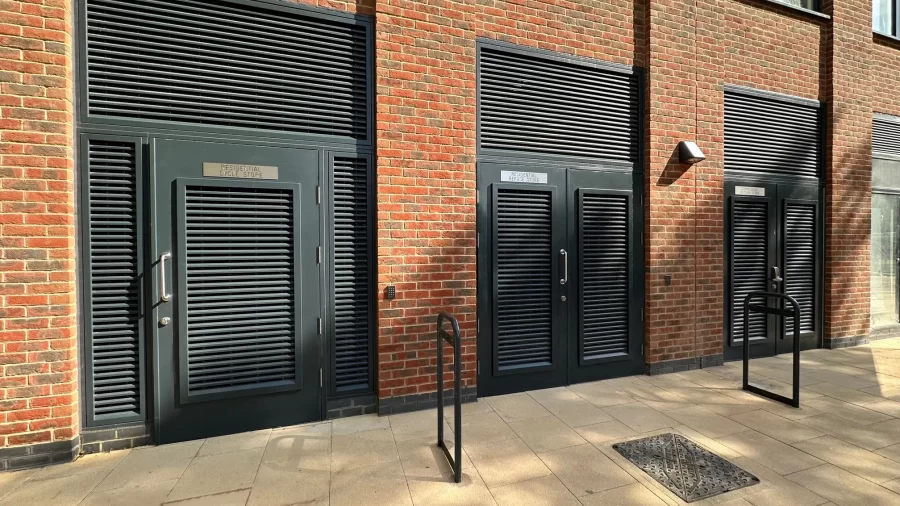
Why door width, leverage and closer efficiency matter when balancing reliable self-closing with accessible opening forces.
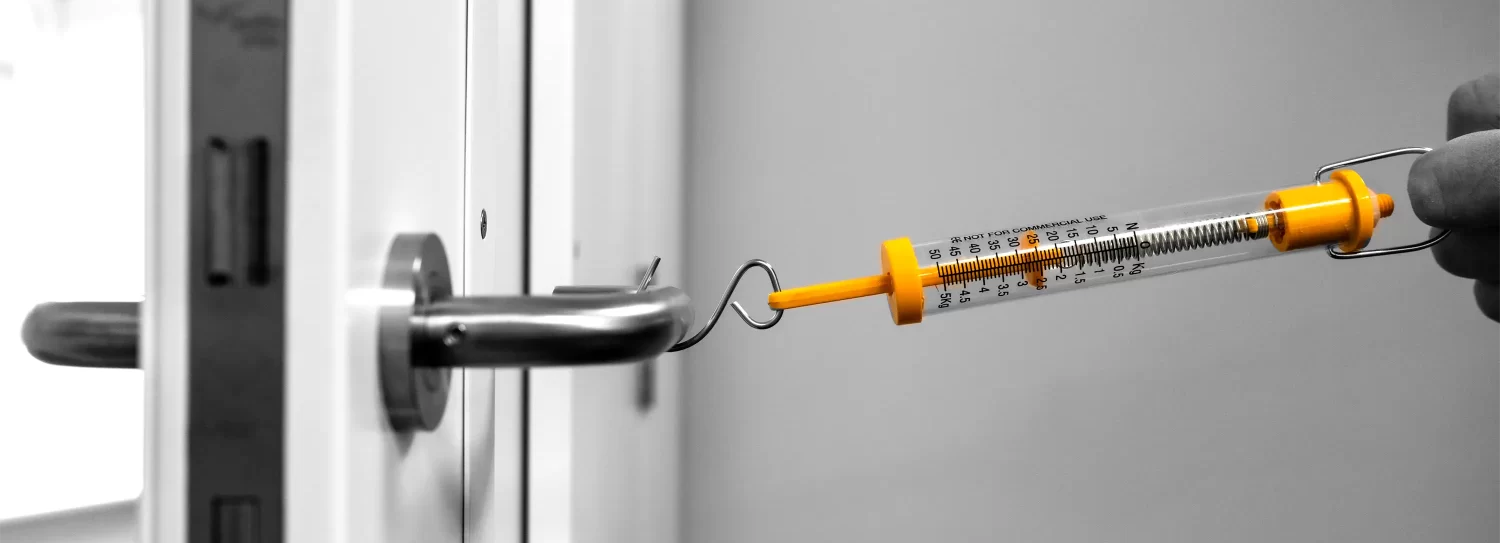
Two Standards, Two Different Measurements
BS EN 1154 expresses door closer performance in moments or torque. BS 8300 considers the linear force the user experiences at the leading edge. They are related, but they are not the same measurement.
Few topics in door hardware generate as much debate as the apparent conflict between BS EN 1154 and BS 8300.
A fire-resisting door must close reliably so that the doorset can perform its intended function. At the same time, a door on an accessible route must not present an unnecessary barrier to the people using it.
The discussion is often reduced to fire safety versus accessibility. That framing misses the engineering at the heart of the problem. BS EN 1154 and BS 8300 approach the door from different directions and use different measurements. Once that distinction is understood, the effect of door width and closer efficiency becomes much clearer.
BS EN 1154: Torque and Closing Capability
BS EN 1154 is the product standard for controlled door closing devices. Its classification system covers matters including category of use, durability, power size, suitability for fire and smoke door assemblies, safety and corrosion resistance.
Power size is linked to test-door mass and recommended maximum leaf width. The standard also sets closing-moment and opening-moment requirements. In engineering terms, this is rotational performance around the pivot, expressed in newton metres (Nm).
The table below is a concise summary of the familiar EN power-size relationship. It is presented for explanation rather than as a substitute for the standard, the closer manufacturer’s Declaration of Performance, fitting instructions or the fire evidence relevant to the doorset.
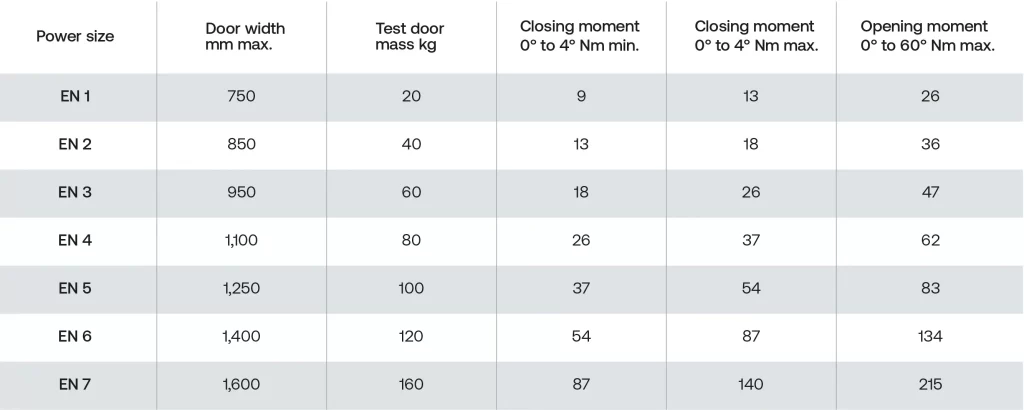
Table 1. Summary of EN 1154 power sizes and moments, based on publicly available manufacturer guidance. Check the current standard and product-specific evidence before specification.
BS 8300: Force at the Leading Edge
BS 8300 considers the force a person experiences when opening the door. The commonly cited recommendations are a maximum of 30 N from 0° to 30° and 22.5 N from 30° to 60°, measured at the leading edge.
This is a linear force, expressed in newtons (N). It is not the same as the closer moment expressed in newton metres. The bridge between the two is leverage.
Torque = Force x Distance
Therefore: Force = Torque ÷ Distance
Why a wider door is easier to open
For a given torque, increasing the distance from the pivot reduces the force required at the leading edge. A wider leaf gives the user a longer lever arm. A narrower leaf gives less leverage, so the same torque results in a higher leading-edge force.
This simple relationship is frequently overlooked. Two doors can use the same closer at the same nominal setting and still produce different opening-force readings because their widths are different.
Worked example: one torque, three door widths
Assume, purely for illustration, that the resisting moment at a particular point in the opening cycle is 18 Nm. Assume also that the force is applied at the nominal leading edge and ignore hinge offset, changing closer geometry, seal drag, latch resistance and other losses.
The leading-edge force can be estimated from F = T ÷ r.
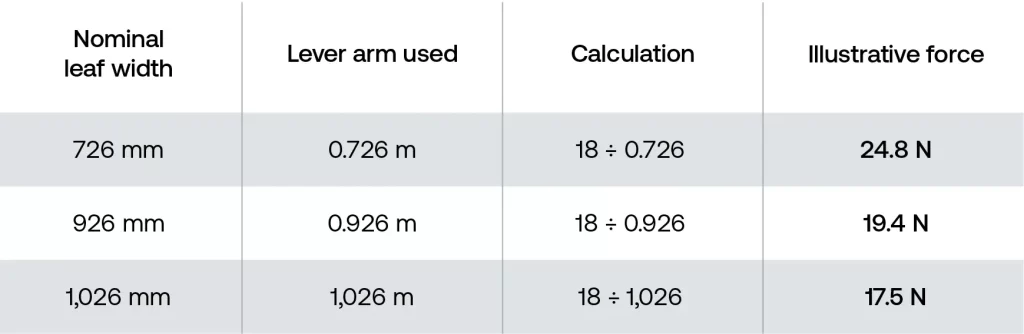
Table 2. Illustrative static conversion only. A real closer’s moment varies through the opening arc, and an on-site force reading includes the whole doorset, not the closer alone.
The 726 mm leaf requires about 42% more leading-edge force than the 1,026 mm leaf for the same assumed 18 Nm moment. Nothing has changed except the available leverage.
This does not predict whether either installed door will comply with BS 8300. It demonstrates why leaf width must be part of any meaningful discussion about opening force.
Closer efficiency: not all closing torque costs the same to create
A door closer stores energy as the door is opened and releases it as the door closes. Some of the user’s input is lost through the mechanism, seals, bearings, hydraulic control and linkage. The closer therefore cannot return all the energy put into it.
In simplified terms: useful closing energy = opening-energy input × efficiency. Rearranged, opening-energy input = useful closing energy ÷ efficiency.
This matters because two closers capable of providing the same useful closing output may demand very different input from the user. A less efficient mechanism needs more input energy to deliver the same output.
A simple efficiency comparison
Assume a door needs 18 units of useful closing work over the relevant part of the cycle. The units are deliberately simplified because actual work depends on the torque through the angular movement.
At 65% efficiency, the required input is 18 ÷ 0.65 = 27.7 units. At 90% efficiency, the required input is 18 ÷ 0.90 = 20.0 units. The 65% efficient device therefore needs about 38% more input than the 90% efficient device to provide the same assumed useful output.
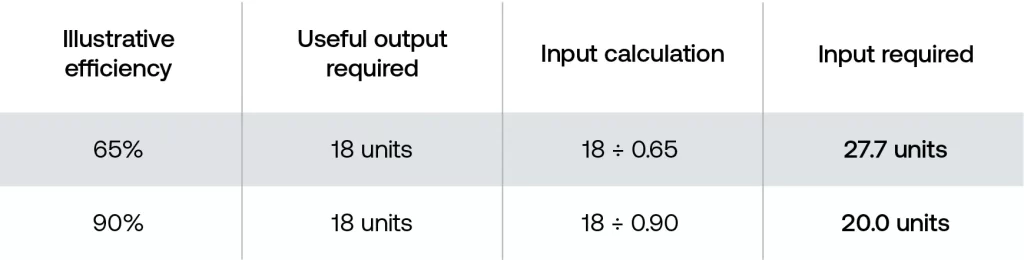
Table 3. Simplified comparison to explain the effect of efficiency. It is not a product-performance calculation or a substitute for manufacturer test data.
Traditional rack-and-pinion closers with projecting scissor arms are widely used and can offer robust, reliable closing. Cam-action closers are designed to change the torque profile through the opening cycle and can reduce the opening effort felt by the user while retaining useful closing performance.
Indicative efficiency figures are sometimes quoted in the industry at around 60% to 70% for conventional scissor-arm arrangements and approaching 90% for some cam-action products. These figures should not be treated as universal values. Actual efficiency and opening characteristics depend on the individual product, arm or slide-channel arrangement, mounting position, power setting and test method. Any published claim should therefore be checked against the relevant manufacturer’s declared or tested data.
Why the closer is only part of the answer
The opening force measured on site reflects the complete installed doorset. Hinge friction, seals, latch alignment, threshold details, frame accuracy, air pressure and maintenance condition all contribute.
A door may therefore exceed the target opening force even when the closer itself is well selected. Simply turning the closer down may reduce opening effort, but it may also leave insufficient energy to close and latch the door reliably, particularly from a small opening angle.
The correct approach is to remove avoidable resistance, select an efficient closer with suitable evidence, and commission the complete assembly against both outcomes: acceptable opening force and dependable self-closing.
What specifiers should consider
- Define the door’s functions, including fire resistance, smoke control, escape, security, acoustic performance and accessibility.
- Check both leaf width and mass against the closer power size and the manufacturer’s instructions.
- Consider the torque profile and efficiency of the closer, not simply the EN power-size label.
- Confirm that the proposed closer, mounting position and accessories are supported by appropriate fire-test, classification or extended-application evidence for the doorset.
- Reduce unnecessary resistance from hinges, seals, latches and installation tolerances before increasing closer power.
- Measure opening force at the prescribed position and through the relevant angular ranges.
- Confirm that the door closes fully and latches from the required opening positions under realistic pressure conditions.
- Record the final settings and include the door closer within the inspection and maintenance regime.
The better question
Rather than asking whether EN 1154 conflicts with BS 8300, it is more useful to ask how the torque needed for reliable self-closing can be delivered without imposing excessive opening force on the user.
The answer depends on the interaction between door width, closer torque, closer efficiency and the resistance of the doorset as a whole. Wider leaves provide more leverage. More efficient closers require less input for the same useful output. Well-aligned hinges, seals and latches preserve more of the available energy.
That is why closer selection cannot be reduced to a single power-size number.
Further help and advice
Metador has access to a wide range of door closer styles and technologies, including products that have been incorporated within successful fire tests and supporting doorset evidence.
The correct solution will depend on the leaf size and mass, required opening characteristics, mounting configuration, intended use and the fire evidence applicable to the complete doorset.
For help selecting a door closer that balances reliable self-closing, accessibility and real-world usability, contact Metador’s technical team.
Technical note and sources
This article is intended as general technical information, not project-specific design advice. Standards, regulatory guidance, product declarations, fitting instructions and fire evidence should be checked for the particular application.
The EN 1154 table in this article is a summary, not a verbatim reproduction of the standard. Torque-to-force and efficiency examples are intentionally simplified to explain the principles. Real door-closer torque varies with opening angle and installation geometry.
- BS EN 1154, Building hardware. Controlled door closing devices. Requirements and test methods.
- BS 8300-2:2018, Design of an accessible and inclusive built environment. Buildings. Code of practice.
- HM Government, Approved Document M, Access to and use of buildings, Volume 2: Buildings other than dwellings.